01
CNC and laser shops
Prepare predictable grayscale input before material and machine time are at risk.
Free depth map generator
Check the source, shape a free depth preview, inspect a low-resolution 3D relief, and compare machine limits before approving one raw-float production bundle.
Live manufacturing workbench
Three free AI previews per day. Source checks, editing, 3D preview, and compatibility exports are free.
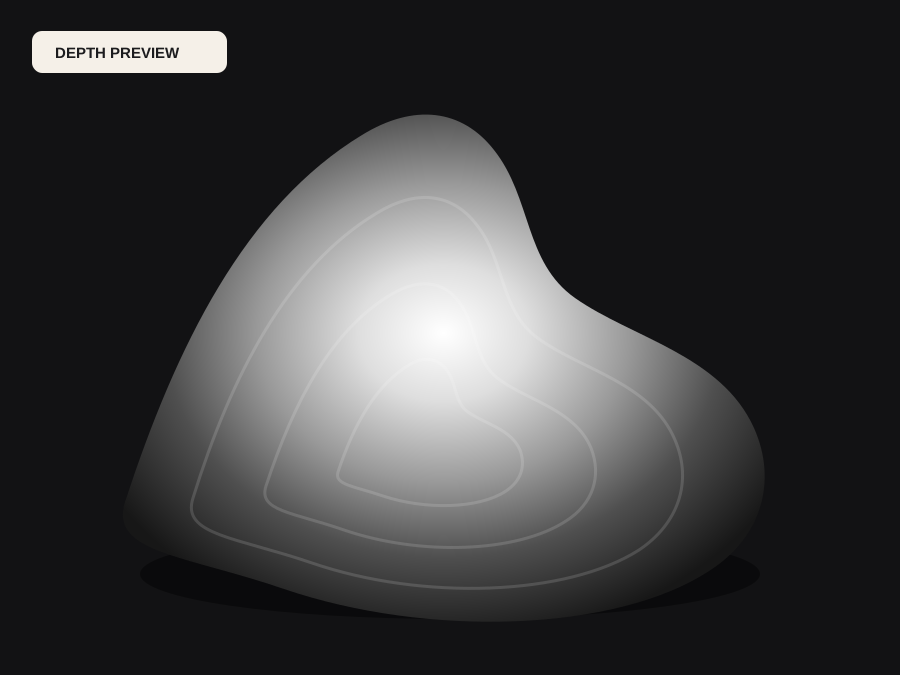
Choose a source image to begin.
Real work, real failure cost
The useful product is not the model call. It is the review loop that catches a reversed field, a noisy border, or an impossible relief before the next tool turns that mistake into wasted time.
01
Prepare predictable grayscale input before material and machine time are at risk.
02
Create a fast depth pass for displacement, parallax, fog, masks, and look development.
03
Validate depth-aware features before moving to a higher-volume API workflow.
01
A depth map is a single-channel image in which brightness represents relative distance. It is not a photograph converted to ordinary grayscale: useful depth estimation separates the foreground, subject, and background according to scene structure. DepthCarve sends a compressed copy of the image to a depth model only after you press Generate, then returns a preview that you can compare directly with the source.
The free downloads include an 8-bit grayscale preview, an honestly labeled compatibility 16-bit container, and a low-resolution closed STL for import checks. The compatibility file is derived from the preview and does not pretend to add precision. After approval, the production job reads raw float EXR and encodes verified forward and inverse 16-bit PNG, a watertight STL, preview, and parameter manifest in one ZIP.
02
Automatic estimates often contain a narrow useful range surrounded by flat gray. Black and white points, Gamma, contrast, inversion, subject threshold, background flattening, source-detail blend, edge-preserving smoothing, taper, and a flat frame let the useful subject occupy the output range. Every adjustment updates the comparison and 3D relief without another model call.
For carving, a good map usually needs a quiet background and gradual transitions across the subject. For VFX, clean object boundaries may matter more than a flat border. The controls remain reversible until approval. Machine inputs then compare beam or tool diameter, depth step, stock thickness, tonal slices, slope, base, manifold topology, and the resulting bounding box.
03
PNG works when another application will interpret brightness: LightBurn, image editors, compositors, displacement tools, and custom pipelines. STL works when the next step expects geometry. The relief exporter builds a top surface, side walls, and a bottom face, producing a watertight mesh instead of a paper-thin height surface. It still needs slicing or CAM setup; it is not unreviewed G-code.
The approved production bundle uses MoGe2 raw float depth rather than the 8-bit preview. One ZIP contains the source EXR, verified true 16-bit forward and inverse maps, an 8-bit preview, a watertight STL, and a versioned parameter and validation manifest. Provider normals, point cloud, GLB, and camera links remain recorded in that manifest and are temporary.
04
A failed social-media effect costs a few seconds. A bad carve can cost a hardwood blank, a long machine slot, and a customer deadline. DepthCarve therefore keeps inspection, shaping, manufacturing checks, and preview files free, grants a new account one approved production job, and returns the reserved credit when a paid provider job fails. The database records job status and ledger entries, not the uploaded source image itself.
No depth model can infer hidden geometry perfectly from one picture. Hair, glass, repeating patterns, shallow relief, and disconnected objects can confuse any estimator. Treat the result as prepared production input, not ground truth. Inspect edges at full size, verify the intended foreground direction, set dimensions deliberately, and run a small scrap test before committing valuable material.
Five bounded stages
Check source contrast, edge detail, border clutter, and resolution before an AI call is trusted.
Adjust the subject mask, background, curve, detail, smoothing, taper, frame, and real dimensions for free.
Compare beam or tool size, tonal slices, slope, base, manifold topology, and bounding box with the real setup.
Approve one successful production job only after the free 2D and 3D previews earn acceptance.
Download one verified ZIP and inspect it in LightBurn, CAM, or a slicer before committing production material.
Choose by next action
| Output | Use it for | It does not guarantee | Cost |
|---|---|---|---|
| 8-bit PNG | Preview, mask, laser and compositing tests | Physical scale or machine settings | Free |
| Compatible 16-bit PNG | Compatibility with grayscale depth workflows | Additional source precision | Free |
| Preview STL | Low-cost scale and import checks | Printability, tool reach, or safe G-code | Free |
| Production job bundle | Raw EXR, true 16-bit pair, STL, preview and manifest | Hidden surfaces or certified metric truth | 1 credit |
Straight answers
Yes. Source checks, complete editing, low-resolution 3D preview, 8-bit PNG, compatible 16-bit PNG, and preview STL are free. One approved raw-float production bundle costs one credit, and a new account starts with one credit.
DepthCarve does not store the uploaded source image in its database. A compressed data URI is sent to the selected inference provider for processing, and provider output links are temporary.
Both can be represented as grayscale, but they describe different things. A depth map estimates distance from a camera; a height map describes elevation from a surface. The same pixels may be remapped for relief work, but the interpretation matters.
No. The STL is closed geometry that must be inspected and converted into toolpaths in CAM software. Choose tooling, feeds, speeds, stock, origin, and safe clearances before machining.
DepthCarve records a unique refund entry and returns the credits automatically. Repeated callbacks or retries cannot create duplicate charges or refunds.
Move from relative depth to a closed, dimensioned relief mesh.
Prepare production input around CAM and material constraints.
Follow the source, range, export, and test workflow.
Understand bit depth before choosing an export container.
Preview the idea. Pay for usable output.
Start without an account. When a professional format earns approval, use the welcome credit or choose a pack that matches the shop's workload.