01
Laser and CNC operators
Judge whether an inferred field is worth cutting before loading material.
AI depth map generator
Send one photograph to a depth model, compare the estimate with the source, and decide whether the inferred structure is good enough to shape into a file your machine reads.
Live manufacturing workbench
Three free AI previews per day. Source checks, editing, 3D preview, and compatibility exports are free.
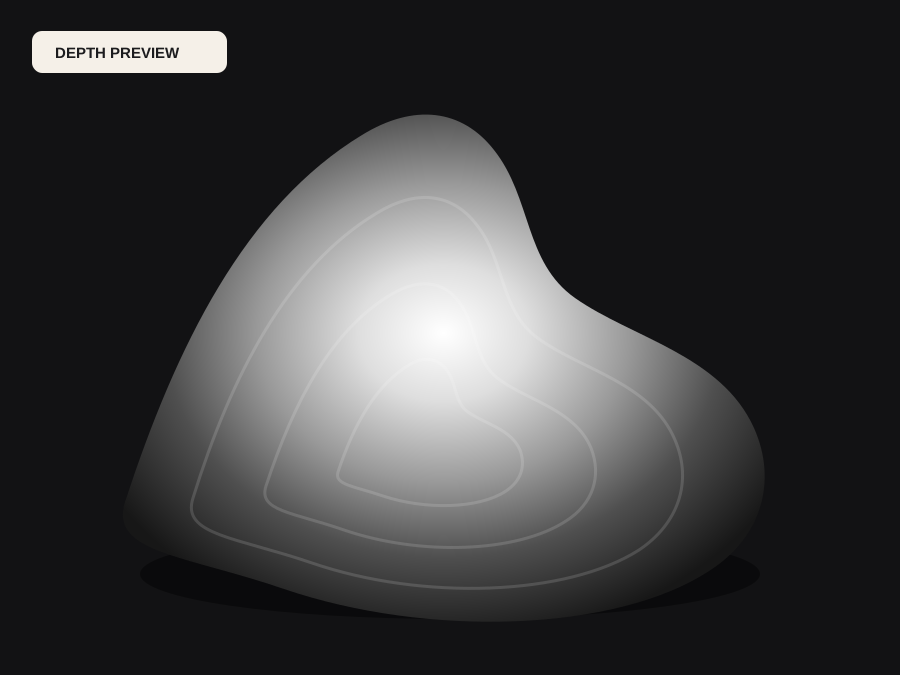
Choose a source image to begin.
Real work, real failure cost
The useful product is not the model call. It is the review loop that catches a reversed field, a noisy border, or an impossible relief before the next tool turns that mistake into wasted time.
01
Judge whether an inferred field is worth cutting before loading material.
02
Get depth from an existing photo instead of buying capture hardware.
03
Test an AI estimate in a prototype before committing to a service contract.
01
A depth model is a network trained on images with known geometry. It infers distance from monocular cues: perspective, occlusion order, relative object size, texture gradient, and the way light falls across a surface. Nothing is measured. A laser rangefinder times a return, stereo rigs compare two viewpoints, and structured light reads a projected pattern; an AI depth map generator recognises the visual habits of the physical world and reproduces them as brightness.
The practical consequence is an ordering, not a survey. Values are relative and normalised, scale is arbitrary until you assign it in millimetres, and objects the camera never saw remain invented. Treat the output as prepared input for shaping, exactly like a rough cut that still needs its finish pass.
02
Reflections defeat the cue. A mirror, a polished countertop, or a window returns a scene the camera is not actually pointed at, and the network happily places that reflected depth inside the frame. Flat, textureless areas leave no gradient to read, so a painted wall may arrive as a soft ramp instead of a plane. Thin structures such as wires, lashes, and fence lines fall between sampled regions and arrive broken or merged into their background.
Cast shadows are the most expensive mistake in a workshop context because they look plausible. A hard shadow under a jaw or a tool is dark, low in the frame, and adjacent to the object, which is precisely the pattern that also signals proximity. The model has no physics to tell the two apart, so the shadow becomes a raised ridge. DepthCarve documents this failure on a real case so the free preview can be read the same way before a blank is loaded.
03
The cheap test is comparison, not measurement. Put the source beside the shaped field, set the wipe to the midpoint, and drag it slowly across the subject. Real structure moves coherently with its edges; invented structure drifts, smears across a boundary, or appears on a surface you know is flat. Then check the direction: near should be the end of the range your receiving tool expects, and the invert control exists because half of all first exports are reversed.
The source readiness report grades usable tonal range, visible edge detail, border clutter, and resolution before a single generation is spent, and the manufacturing panel then compares the shaped field against beam diameter, depth step, stock, tonal slices, and slope. Both panels are explainable heuristics rather than certification, and both are free, which is the point: rejection should always be the cheaper outcome.
04
DepthCarve compresses the image in your browser, sends that compressed copy to the selected inference provider only when you press Generate, and does not store the source image in its database. Three AI previews per day are free, and shaping, comparison, the 3D relief preview, and every compatibility export remain free afterwards, because the range decisions are where the real work happens.
One approved production job costs one credit and adds what the free preview cannot contain: raw floating-point depth, a true 16-bit forward and inverse pair, a watertight mesh, and a versioned manifest. New accounts include one welcome credit, a failed provider call returns its debit automatically, and re-encoding the same approved job never charges twice.
Five bounded stages
Check source contrast, edge detail, border clutter, and resolution before an AI call is trusted.
Adjust the subject mask, background, curve, detail, smoothing, taper, frame, and real dimensions for free.
Compare beam or tool size, tonal slices, slope, base, manifold topology, and bounding box with the real setup.
Approve one successful production job only after the free 2D and 3D previews earn acceptance.
Download one verified ZIP and inspect it in LightBurn, CAM, or a slicer before committing production material.
Choose by next action
| Output | Use it for | It does not guarantee | Cost |
|---|---|---|---|
| 8-bit PNG | Preview, mask, laser and compositing tests | Physical scale or machine settings | Free |
| Compatible 16-bit PNG | Compatibility with grayscale depth workflows | Additional source precision | Free |
| Preview STL | Low-cost scale and import checks | Printability, tool reach, or safe G-code | Free |
| Production job bundle | Raw EXR, true 16-bit pair, STL, preview and manifest | Hidden surfaces or certified metric truth | 1 credit |
Straight answers
No. A measured map comes from a sensor that timed or triangulated a physical return. An AI map is inferred from visual cues in one photograph, so it carries relative ordering and invented geometry rather than metric accuracy.
Mirrors, glass, polished metal, water, flat untextured walls, repeated patterns, hair, wires, and heavy cast shadows are the usual failures. They either remove the cues the network needs or supply a cue that means something else physically.
The preview is inspected at screen size and the result is inspected in raking light on a physical object, where a wrong ridge from a shadow or a reflection becomes obvious. Check the field against the source at full size before approving a production job.
Only after you assign scale, and only where the visible surface is what matters. Hidden sides, cavities, and true distances behind an occluder are not recoverable from one photograph by any estimator.
Preview the idea. Pay for usable output.
Start without an account. When a professional format earns approval, use the welcome credit or choose a pack that matches the shop's workload.