01
Motion designers
Build quick 2.5D movement and depth-driven effects.
VFX depth map generator
Estimate scene layers for parallax, atmosphere, masks, and look development. Remap the range around the shot instead of forcing every project into one automatic grade.
Live manufacturing workbench
Three free AI previews per day. Source checks, editing, 3D preview, and compatibility exports are free.
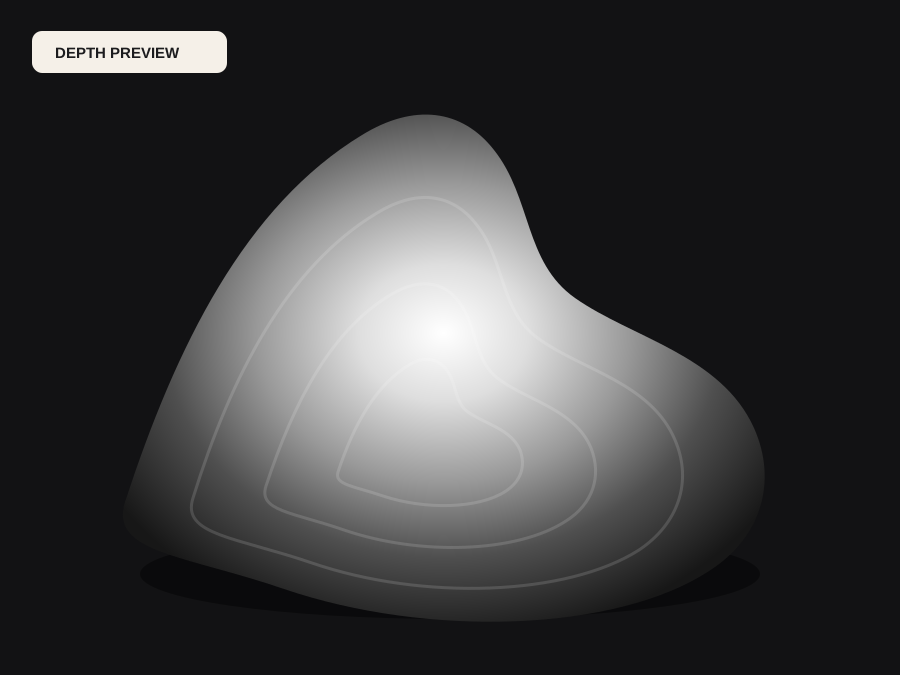
Choose a source image to begin.
Real work, real failure cost
The useful product is not the model call. It is the review loop that catches a reversed field, a noisy border, or an impossible relief before the next tool turns that mistake into wasted time.
01
Build quick 2.5D movement and depth-driven effects.
02
Prototype fog, blur, masks, and grading by distance.
03
Approve depth-aware still treatments before heavier production.
01
A parallax move needs the foreground separated clearly from the plate, so a contrasty range with a firm near value is more useful than an even one. Atmospheric fog needs the opposite: a long, smooth gradient through the background so distance accumulates gradually. The same estimate serves both only after the range has been shaped deliberately.
That is why the black point, white point, gamma, and flattening controls matter more here than raw estimation quality. Grading a depth pass is a compositing decision, and the tool treats it as one: adjustments are applied to the field and previewed immediately, without another model call.
02
Hair, glass, reflections, motion blur, and occlusion boundaries are the recurring failures. A single-view estimator has no way to know that a strand is separate from the wall behind it, and it cannot see through a window. Those regions need a holdout mask, a manual edge, or a different approach for final-pixel work.
The comparison view exists to find them before they reach a comp. Zoom to the boundary, look for a halo or a stair-step along a hard silhouette, and decide then whether the estimate is good enough or whether the shot needs rotoscoping.
03
The current tool processes single images. It does not enforce temporal consistency, so applying it frame by frame produces flicker that no amount of cleanup makes acceptable for final footage. A still pass is for look development, plate prep, matte painting, and 2.5D animation from a locked image.
If a shot needs motion, treat the still pass as a reference for a temporal pipeline rather than a source of frames. When more than a grayscale plate is required, the production bundle adds raw float depth and, when the provider returns them, normals, a point cloud, a GLB, and camera information for the shot.
Five bounded stages
Check source contrast, edge detail, border clutter, and resolution before an AI call is trusted.
Adjust the subject mask, background, curve, detail, smoothing, taper, frame, and real dimensions for free.
Compare beam or tool size, tonal slices, slope, base, manifold topology, and bounding box with the real setup.
Approve one successful production job only after the free 2D and 3D previews earn acceptance.
Download one verified ZIP and inspect it in LightBurn, CAM, or a slicer before committing production material.
Choose by next action
| Output | Use it for | It does not guarantee | Cost |
|---|---|---|---|
| 8-bit PNG | Preview, mask, laser and compositing tests | Physical scale or machine settings | Free |
| Compatible 16-bit PNG | Compatibility with grayscale depth workflows | Additional source precision | Free |
| Preview STL | Low-cost scale and import checks | Printability, tool reach, or safe G-code | Free |
| Production job bundle | Raw EXR, true 16-bit pair, STL, preview and manifest | Hidden surfaces or certified metric truth | 1 credit |
Straight answers
The launch workflow is for still images. Frame-by-frame use may flicker because temporal consistency is not enforced. A dedicated video pipeline is required for final footage.
Treat those regions as holdouts. Use the depth pass for the body of the frame, and rotoscope or mask the places where a single-view estimate cannot separate foreground from background.
The 8-bit grayscale PNG is usually enough to grade and preview. Take the production bundle's true 16-bit pair when the comp needs finer graduations through the background or long ramps for fog.
Relative. Values describe ordering and normalised distance from one viewpoint, with no absolute scale. Set the near and far interpretation inside your compositor rather than expecting metres.
Preview the idea. Pay for usable output.
Start without an account. When a professional format earns approval, use the welcome credit or choose a pack that matches the shop's workload.