3D Printing
Lithophane & 3D printed relief STL thickness guide (2026 FDM & resin settings)
There are two completely different ways to 3D print a photograph in 2026: **backlit lithophanes** (where thin walls pass bright light and thick walls block light based on pixel luminance) and **front-lit 3D bas-relief sculptures** (where true geometric depth pushes faces and bodies forward into physical 3D relief). Confusing the two ruins prints instantly. DepthCarve supports both cleanly—giving you a dedicated local lithophane workflow plus true 16-bit depth-estimated watertight STLs ready for Bambu Studio, PrusaSlicer, OrcaSlicer, and Chitubox.
Start with an image or the sample. No account needed for the preview.
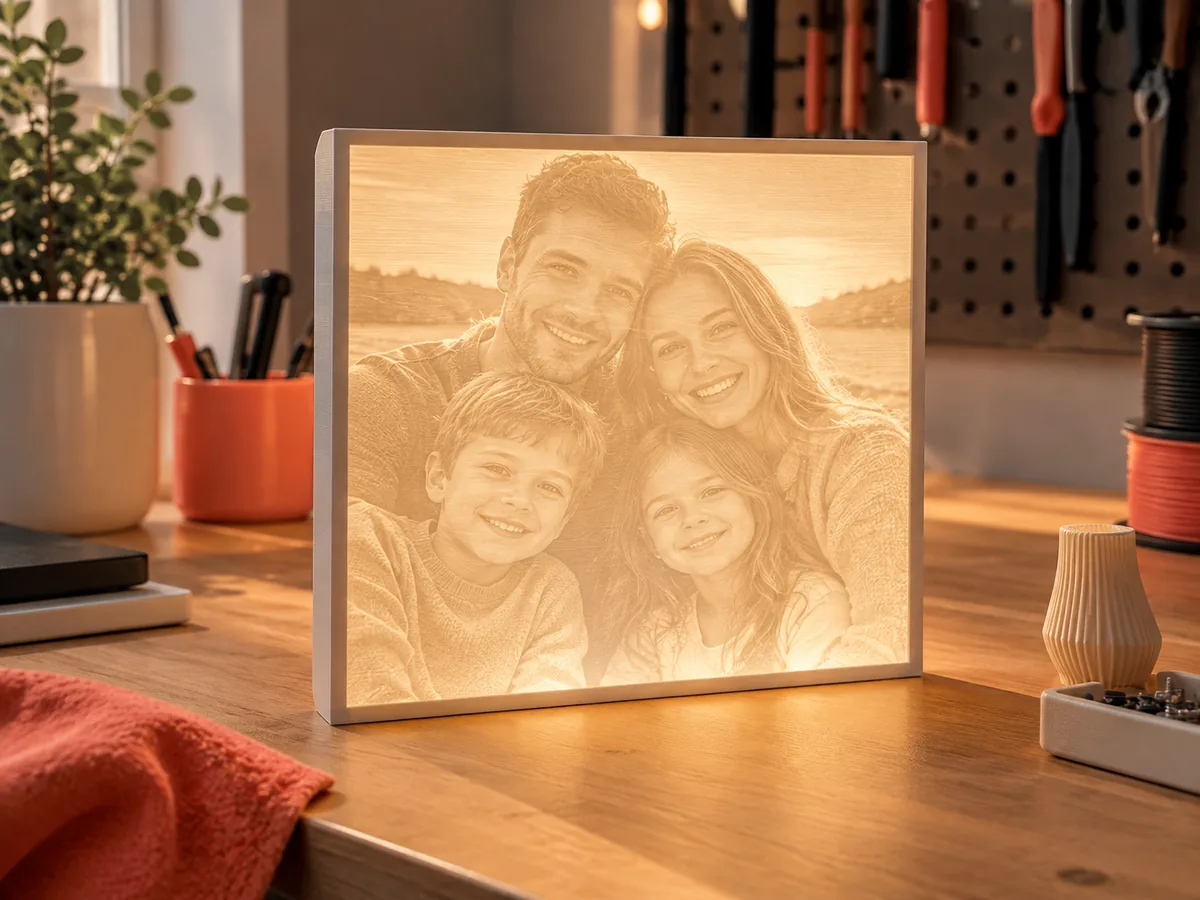
Backlit lithophane vs front-lit bas-relief STL: pick the right physics
Before exporting an STL, decide how the finished print will be illuminated. A **backlit lithophane** works like an optical filter: light shines from *behind* white or ivory filament, so bright photo highlights must be thin (typically 0.8 mm) and dark shadows must be thick (typically 3.0 to 3.4 mm). Luminance—not 3D camera distance—governs thickness.
A **front-lit 3D bas-relief** (like a resin portrait medallion, decorative tile, or painted plaque) works under *front or side room lighting*: the nose, forehead, and hands must physically protrude forward of the background even if the subject wears dark clothing or has dark hair. That requires true monocular depth estimation—exactly what DepthCarve's neural production pipeline exports as a closed watertight STL.
| Print Type & Machine | Min / Max Thickness | Orientation & Walls | Layer Height & Infill |
|---|---|---|---|
| FDM Backlit Lithophane (0.4 mm nozzle) | 0.8 mm min · 3.0–3.2 mm max | Print **vertically along Y-axis** + 8 mm brim | 0.12 mm layer · 99%–100% rectilinear infill (or 6+ walls) |
| FDM Front-Lit Relief (PLA / Matte PLA) | 2.0 mm base + 4.0–6.0 mm relief | Vertical or 60° tilt for highest facial detail | 0.10–0.12 mm layer · 15% gyroid infill · 3 walls |
| MSLA Resin Relief Medallion (8K–12K) | 2.5 mm base + 3.5–5.0 mm relief | 35°–45° tilt with medium supports on back face | 0.03–0.05 mm layer · solid or hollowed > 6 mm |
Try the workflow
Convert brightness to thickness locally
Bright areas become thin and dark areas thick. Set millimeter dimensions and export a free low-resolution STL, without an AI job or credits. The geometry preview cannot replace a backlit test print.
Local lithophane workbench
Upload a photo. Turn brightness into thickness.
Processed in your browser, without sign-in or credits. Bright areas are thinner; dark areas are thicker. AI scene depth is not used for a backlit photo.
Choose a source image to begin.
Why vertical orientation triples resolution on FDM printers
Beginners almost always lay a relief or lithophane STL flat on the build plate—and wonder why the portrait looks muddy and stepped. On an FDM printer, X/Y nozzle width is roughly 0.40 mm while Z layer resolution is 0.10–0.12 mm, meaning a flat print has only 18 to 24 physical height steps across a 2.4 mm lithophane!
Standing the panel **vertically** (aligned parallel to the bed-slinger's Y-axis so bed acceleration never wobbles the thin wall) maps image height onto crisp 0.12 mm Z layers and thickness onto continuous sub-millimeter X/Y extrusion paths. Add an 8 mm outer brim and slow outer wall speed to 35–45 mm/s for crisp eyelashes and zero ghosting.
Filament transmission distance (TD) and matte finishes for clean contrast
For backlit lithophanes, cool white or warm ivory PLA with a transmission distance (TD) around 3.0 to 4.5 mm gives full tonal separation between 0.8 mm highlights and 3.2 mm deep blacks. Silk or glossy translucent filaments scatter internal light sideways and wash out eyes. Always calibrate your specific spool with a simple 10-step thickness calibration strip (0.4 mm to 4.0 mm) held in front of the exact LED puck or window light you plan to ship with the gift—warm 2700K LEDs need slightly thinner shadows (2.8–3.0 mm max) than cool 5500K panels so dark hair never turns into an opaque black blob.
For front-lit bas-relief sculptures, skip backlit luminance formulas entirely and use matte marble PLA, matte terracotta PLA, or neutral gray 8K/12K photopolymer resin. Matte micro-textures diffuse overhead glare so real 3D carved geometry—not shiny plastic reflections—defines eyebrows, noses, and drapery. On MSLA resin printers, angle the watertight relief medallion 35° to 45° backward with medium supports strictly on the flat back plane so the sculpted portrait face never suffers support dimples.
Why watertight STLs eliminate slicer repair errors
Nothing stalls a batch print faster than PrusaSlicer or Bambu Studio flagging '4,218 non-manifold edges' on an open heightmap shell. Unclosed displacement meshes force slicers to guess interior solid regions, occasionally filling hollow background gaps or slicing a 0.2 mm floating skin that snaps off the build plate mid-print. Every DepthCarve production bundle generates a closed, manifold watertight STL with verified outward normals, sealed perimeter skirts, and a clean flat backing plane—ready to slice immediately at $0.26/file on the $39 Shop Pack (150 non-expiring credits).
Print farms selling personalized lamps, curved night-lights, and resin memorial medallions also value consistency across reorders. Because every DepthCarve ZIP includes the raw floating-point EXR, true 16-bit PNGs, closed watertight STL, and a JSON manifest recording exact clipping bounds and target Z-height, scaling a 100 mm desk lithophane up into a 200 mm framed anniversary box six months later takes thirty seconds instead of rebuilding the sculpt from scratch. Before starting an overnight 14-hour print on Bambu Lab, Prusa, or Elegoo hardware, inspect the exported mesh in our browser-local STL Viewer to verify wall continuity, smooth cheek curvature, and crisp base-plane flatness without leaving your browser. Pairing verified watertight meshes with standardized white PLA spools and repeatable slicer profiles keeps print-farm failure rates near zero during peak holiday order surges.
Before the file moves forward
Final checklist
- Choose backlit lithophane (luminance) vs front-lit bas-relief (true 3D depth) before exporting.
- Stand FDM lithophanes vertically along the Y-axis with an 8 mm brim.
- Set 0.12 mm layer height and 100% infill (or 6+ perimeters) on backlit lithophanes.
- Use neutral matte PLA or 8K gray resin for front-lit 3D relief sculptures.
- Import DepthCarve's closed watertight STL directly into Bambu Studio, PrusaSlicer, or Chitubox.
Straight answers
Questions this workflow raises
What thickness should a 3D printed photo lithophane be?
Use 0.8 mm minimum thickness for pure white highlights and 3.0 to 3.2 mm maximum thickness for dark shadows with standard white PLA (TD ~3.5 mm).
Should I print a photo relief STL flat or standing upright?
Standing upright (aligned with the Y-axis on bed-slingers) dramatically increases tonal resolution on FDM printers; resin printers perform best at a 35°–45° tilt with supports strictly on the flat back.
Are DepthCarve STLs watertight for Bambu Studio and Chitubox?
Yes. Every 1-credit production export builds a closed manifold watertight STL with a flat back plane and verified normals.
How much does a production watertight STL cost on DepthCarve?
One credit ($0.40 on Maker $12/30 or $0.26 on Shop $39/150, never expires) delivers the watertight STL alongside raw EXR and true 16-bit PNGs.
No-login product advisor · Grounded in live export specs
Questions before exporting? Get straight answers on 16-bit depth, CAM & billing
Why does true 16-bit PNG matter for CNC wood relief and fiber laser engraving?
Standard 8-bit grayscale has only 256 height steps, which produces visible stair-stepping bands across faces and shallow curves. One DepthCarve production credit decodes raw floating-point EXR depth into 65,536-level true 16-bit forward and inverse PNGs plus a verified watertight STL.